In honor of National Safety Month, Sprague’s Director of Safety Jeff Musk shared his perspective on what it takes to maintain safe operations: “There is nothing so important that we cannot take the time to do it safely.” It’s a straightforward idea with a real point behind it: safety works best when it is an organizational value, practiced consistently, and owned by everyone. That’s the foundation of Sprague’s effective safety culture, and it shows up in everything from how a terminal operator gears up for a shift to how a crane operator handles an unexpected situation when discharging a vessel.
Every June, the energy and industrial sectors observe National Safety Month, a shared moment to pause, take stock of safety programs, and reinforce a culture of prevention. For Sprague, it’s also an opportunity to pull back the curtain on the systems and habits that keep people safe year-round. From personal protective equipment (PPE) standards and “Good Catch” reporting programs to fleet training and environmental preparedness drills, here is a closer look at how that works in practice.
PPE: The Final Layer of Protection
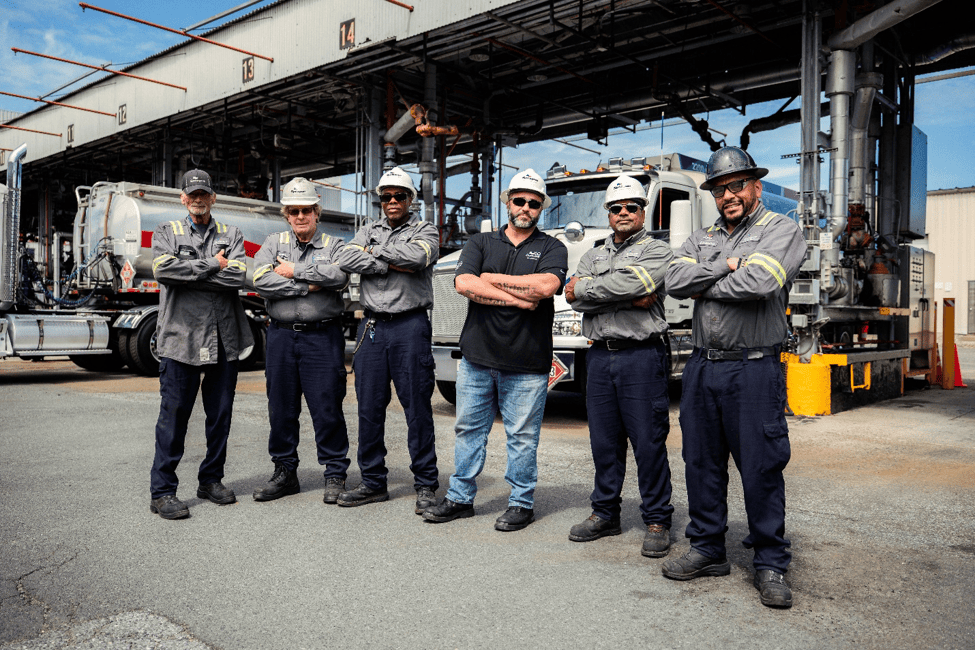
At Sprague’s terminals, every team member gears up before stepping outside. Hard hats, eye protection, safety-toe boots, and life jackets are standard across terminals, and for good reason. In fast-moving environments like a working dock, the margin for error is small. A hard hat takes a matter of seconds to put on. The risk of not wearing one can last a lifetime.
Sprague maintains a PPE matrix that maps protective gear to specific operations or jobs across terminals. The matrix removes guesswork: employees know what to wear, where to wear it, and why. Consistent compliance with PPE standards is the final line of defense against personal injury, should all else fail.
The Systems Behind Safe Operations
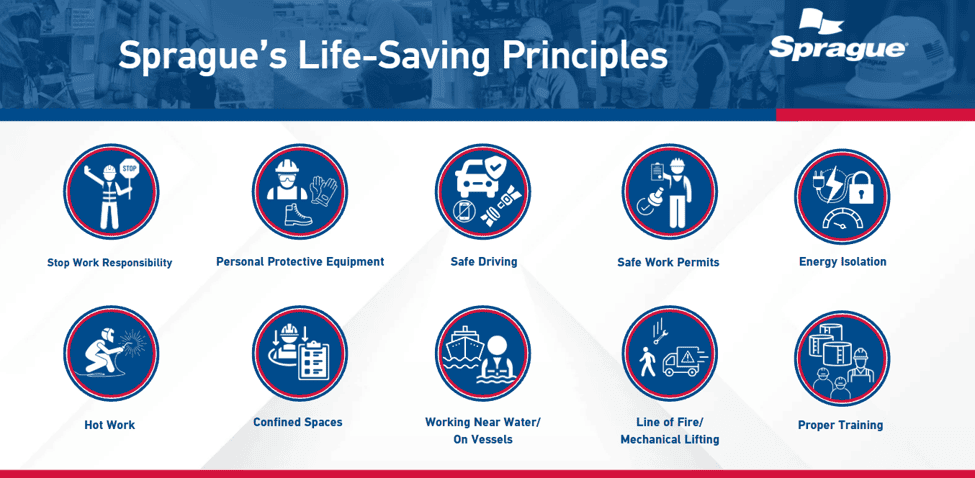
Behind every safe terminal is a set of systems working in the background. Most recently, Sprague developed ten Life Saving Principles (LSPs) that reinforce non-negotiable safety practices and instituted observational safety walks involving personnel from the terminal as well as representatives from operations, engineering, and the health and safety teams. Both initiatives required a collaborative investment of time and expertise to promote positive practices, identify deficiencies in real time, and address them before they become incidents. These walkarounds are not the sole responsibility of the safety team. Operations lead them too, because frontline awareness is often where risk gets caught earliest.
These practices align with the safety standards set by Hartree, Sprague’s parent company. Hartree’s Safety Action Item Calendar provides a monthly framework for consistent attention to critical topics across all terminals, including dock safety, fall protection, hazardous energy control, safety equipment, and emergency preparedness. The result is a safety program that is planned and repeatable, not improvised.
Sprague’s Safety Performance Committee brings this structure to life at the governance level. The committee draws from Terminal Operations, HSE, HR, and Risk Management to review incidents, evaluate Good Catch reports, analyze safety trends, and recommend recognition for safe performance. Cross-functional oversight like this helps prevent gaps from falling between departments.
Proactive Reporting: The Good Catch Program
During a recent gypsum vessel discharge at one of Sprague’s terminals, a crane operator noticed something was off. The loader they had been asked to lift looked larger than the others in the operation. Rather than proceed, the operator paused and asked to confirm the weight was within the rated capacity for the spreader bar being used. It was not. The crane operator exercised Stop Work Authority, the loader was removed from the operation, and a potential incident was avoided entirely.
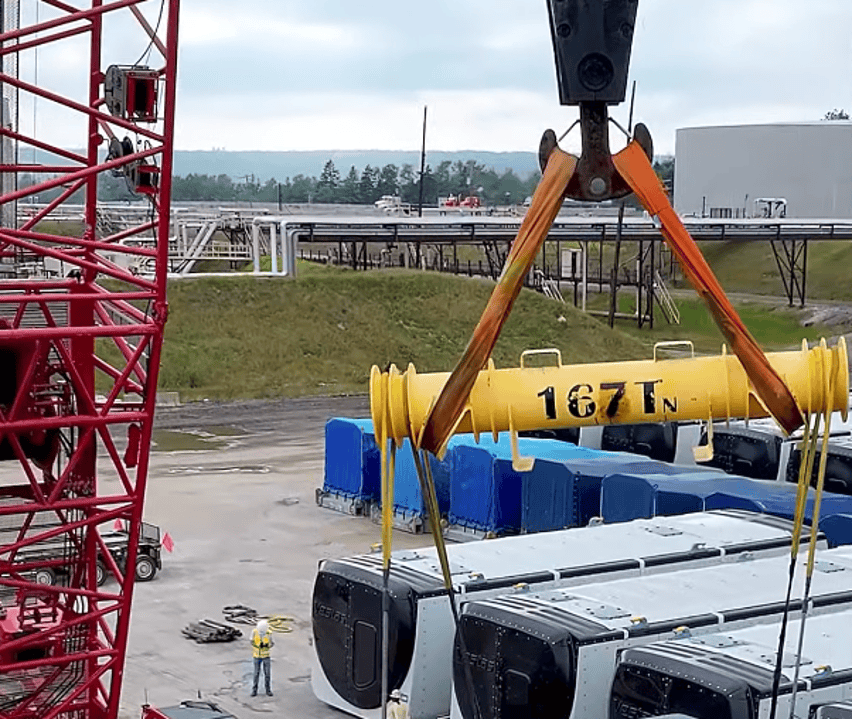
That is exactly the behavior Sprague’s Good Catch program is designed to encourage. Launched in 2019, Good Catch gives employees a formal channel to report conditions that could lead to an incident before anything happens. Across Sprague’s facilities, employees proactively flag physical, chemical, thermal, and noise hazards. Once reported, solutions and controls are put in place to eliminate or reduce those risks.
The program reinforces a simple but important idea: a near miss is not something to brush past. It is something to learn from.
Learn more about Sprague’s health and safety procedures.
Fleet Safety and Driver Training Programs
Frequently, Sprague brings a tanker truck to Touch a Truck events, where the public is invited to climb in and see what a licensed commercial driver (CDL) actually sees from behind the wheel. The goal of participating in these events is simple: most drivers on the road have no idea how limited the sightlines of large commercial vehicles are. Blind spots that go unnoticed by other drivers are a daily reality for Sprague’s drivers.
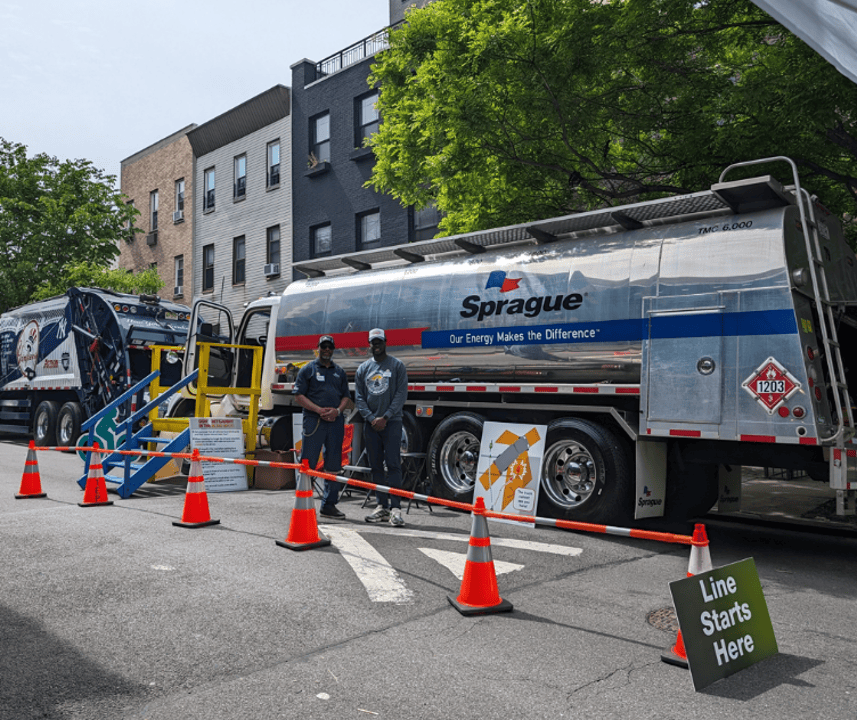
By giving the public a direct look at those limitations, Sprague helped build awareness that extends beyond its own fleet. Shared roadways are safer when all drivers understand how large vehicles operate.
That community-facing work is one part of a broader fleet safety program that includes certified driver trainers, on-road observations, coaching, and vehicle monitoring technology. Driver safety is treated as an extension of terminal safety, not a separate category.
Environmental Preparedness and Emergency Response Twice a year, the team at Sprague’s Newington, NH terminal runs a full boom deployment drill. Booms are unloaded into the water and anchored to simulate containing an oil spill. The goal is to be ready to respond to an emergency in under an hour. Third-party evaluators are brought in to validate the drills, providing an independent check on readiness.
This kind of preparation does not happen by accident either. Sprague’s environmental preparedness program includes spill response readiness drills and emergency planning that aligns with Hartree’s broader preparedness expectations, including evacuation drills and equipment inspections. Proactive planning is what keeps a potential environmental incident from becoming an actual one.
Safety as a Shared Responsibility
All of these systems, the PPE matrix, the Good Catch program, the safety committee, come back to the same idea: safety works when everyone takes ownership of it. Stephen Barber, a Terminal Operator at Sprague’s Rensselaer Terminal, recently marked 35 injury-free years with the company. His career is a reminder that safe work habits, practiced consistently over time, make a real difference.
That kind of record is not built in a single moment. It is built one shift at a time, one decision at a time, by someone who understands that safety is not someone else’s job.
Keep Safety at the Forefront
At Sprague, safety is not a standalone initiative. It is embedded into how we operate every terminal, manage every fleet movement, and engage every employee.
Through structured programs, community involvement, and the everyday decisions of our team, we are committed to continuous improvement and proactive risk management. Backed by more than 150 years of operational experience and supported by Hartree’s global expertise, Sprague continues to strengthen its safety culture across every level of the organization.
Learn more about how Sprague approaches operational excellence, safety, and reliability across its energy network.