Sprague Regulatory Matters is provided as a courtesy to our customers. Please note that the information contained in Sprague Regulatory Matters is for informational purposes only and should not be construed as legal or business advice on any subject matter. You should not act or refrain from acting on the basis of any information included in this without seeking legal or professional advice.
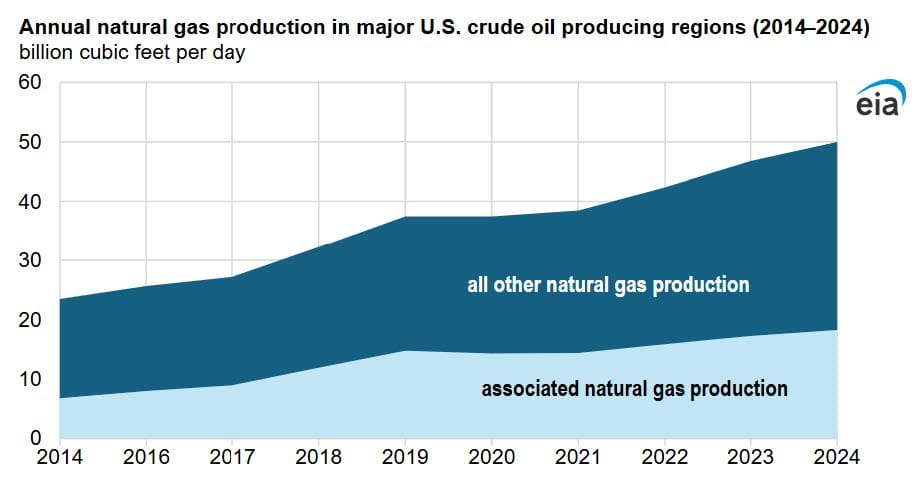
Natural Gas Production Increased in 2024
National – Electric & Natural Gas
The U.S. Energy Information Administration (EIA) reported (U.S. associated natural gas production increased 6% in 2024 – U.S. Energy Information Administration (EIA)) that the production of associated natural gas, increased by 6 percent in 2024, mirroring the growth in crude oil production from the Permian region. Associated natural gas production averaged 18.5 billion cubic feet per day (Bcf/d) in 2024.
Regional Grid Operators Anticipate Adequate Electric Supplies This Winter
Regional – Electric
Regional electric grid operators expect to have ample electric generation resources available during the winter 2025-2026 period:
ISO New England (ISO-NE): ISO-NE projects that the region is well-positioned this winter season (New England expected to have sufficient electricity supplies this winter – ISO Newswire). Winter electricity demand is expected to peak at 20,056 megawatts (MW) under normal weather conditions, and peak at 21,125 MW under extreme cold weather conditions. This is similar to last winter when demand peaked at 19,607 MW on January 22, 2025. ISO-NE expects to have roughly 31,000 MW of available capacity.
New York ISO (NYISO): NYISO anticipates that there is adequate capacity to meet electricity demand this winter season (PRESS RELEASE | NYISO’s Winter Readiness Assessment: Adequate Capacity but Concerns Remain Under Extreme Weather – NYISO) under forecasted conditions; however, there are some concerns over fuel security for electric generators during extreme weather events. Winter electricity demand is forecasted to peak at 24,200 MW with 29,893 MW of power resources available. Electric demand peaked last winter at 23,521 MW on January 22, 2025. Aaron Markham, NYISO vice president of operations stated, “In general, winter reliability of the grid is a growing concern, especially during extended cold snaps and other extreme weather.”
PJM (Pennsylvania-New Jersey-Maryland) Interconnection (PJM): The PJM Interconnection1 anticipates having sufficient resources to serve the 67 million people in its footprint this winter under anticipated conditions (PJM Winter Outlook: Adequate Power Supplies Available To Serve Growing Demand Under Expected Conditions | PJM Inside Lines). PJM expects to have 180,800 MW of operational capacity to serve a forecasted peak electricity demand of approximately 145,700 MW. This would set a new record if reached. PJM reached an all-time winter high electric demand of 143,700 MW on January 22, 2025 – 2,000 MW less than this winter’s forecast peak.
New York Revises State Energy Plan
New York – Electric & Natural Gas
New York has approved a new state energy plan (New York State New Energy Plan – New York State New Energy Plan) that recognizes a continuing need for natural gas-fired power generation through 2040, essentially declaring that the state’s goal of fully decarbonizing its power sector by that year is out of reach. The New York State Energy Planning Board approved the plan unanimously at a December 16th meeting. Board members noted that surging power demand, changing policies in Washington, DC, and the need to maintain reliability and affordability of the power grid made the policy change necessary. “It is my opinion, and an opinion echoed in the plan, that an all-of-the-above energy approach isn’t simply a choice; it’s our reality,” said New York State Public Service Commission Chair and CEO Rory Christian, one of the planning board members. Christian stressed that “we need to embrace the word ‘transition’ at its core,” defining the word to mean “a managed period of change while an existing system continues to function while being deliberately transformed into a new one.” Doreen Harris, President and CEO of the New York State Energy Research and Development Authority and chair of the planning board, echoed those sentiments. “I myself have been most impressed with the conclusion of this plan that, in order to keep our energy system reliable and resilient, it is imperative that we consider the full spectrum of energy resources,” Harris said.2
Law Eliminates the 100-Foot Rule for Natural Gas Hookups
New York – Natural Gas
Governor Hochul signed legislation that will eliminate the 100-foot rule for natural gas hookups (Governor Hochul Signs Legislation to Eliminate Unfair Utility Subsidy That Passes the Buck for New Residential Gas Hookups to All Customers | Governor Kathy Hochul). The new law, which will become effective in 12 months, only applies to residential buildings. It does not prohibit new gas hookups and utilities still have a legal obligation to provide service; however, the law shifts the cost of the connection to the applicant as opposed to socializing it among other utility ratepayers.3
Inquiry Regarding The Future of Natural Gas
Maine – Natural Gas
The Maine Public Utilities Commission has initiated an inquiry to explore the implications of Maine’s decarbonization goals for natural gas utilities and their customers (Maine Public Utilities Commission Homepage | MPUC). The Commission will hold a workshop4 to develop a methodology or framework to incorporate and evaluate the greenhouse gas emissions impact in the Commission’s decision making regarding natural gas infrastructure investments and contractual commitments for natural gas supply and/or capacity needed to serve customers.
Federal Energy Regulatory Commission Restored to Full Contingent
Federal – Electric & Natural Gas
President Trump designated Laura Swett as Chairman of Federal Energy Regulatory Commission (FERC) on October 23, 2025. Chairman Swett was nominated by President Trump on June 2, 2025, and confirmed by the Senate on October 7, 2025, to serve on the Commission for a term expiring on June 30, 2030. David LaCerte was sworn in as a Commissioner on October 27, 2025. He was nominated to serve on the Commission by President Trump on July 17, 2025, and confirmed by the Senate on October 7, 2025, for a term expiring on June 30, 2026. This restores the FERC to a full contingent of five commissioners. Chairman Swett has indicated her support for natural gas and noted that the FERC will be focused on finding ways to speed up permitting.
NARUC Seeking Federal Support of Investment in Natural Gas Infrastructure
National – Natural Gas
State utility commissioners are calling on federal policymakers to back continued investment in natural gas and the related infrastructure development. The National Association of Regulatory Utility Commissioners (NARUC) board of directors approved three gas committee resolutions at the organization’s annual meeting in Seattle (Annual Meeting – NARUC). The first resolution, GS-1, describes natural gas as having a foundational role in the energy future of the U.S. The other two, GS-2 and GS-3, focus on permitting reforms and certainty for infrastructure development. GS-1, sponsored by NARUC President Tricia Pridemore, indicates that the organization “supports the continued investment in energy infrastructure including natural gas, that will be necessary to keep energy costs affordable while meeting growing demands in the years ahead.”
New York Electric Grid Operator Raises Concern for Future Operations
New York – Electric
The New York Independent System Operator (NYISO) issued its Draft 2025–2034 Comprehensive Reliability Plan (2025-2034 Comprehensive Reliability Plan). The draft report raises a number of reliability concerns (PRESS RELEASE | NYISO Planning Studies Highlight Grid Reliability Concerns – NYISO) including: (1) the New York electric grid faces increased risk of power shortages over the next five years unless planned projects, including new transmission and offshore wind resources, are brought online; (2) starting in summer 2026, NYISO anticipates its reliability margins in New York City will be dangerously thin, making the grid more vulnerable to potential failures; and (3) the aging of the existing generation fleet, the rapid growth of large loads, and the increasing difficulty of developing new dispatchable resources add to the challenges ahead.
Proposed Changes to Electric Renewable Portfolio Standard
New Hampshire – Electric
Legislation introduced in the New Hampshire House of Representatives, House Bill 219 (NH HB219 | 2025 | Regular Session | LegiScan) aims to alter the structure of the electric Renewable Portfolio Standard, that sets goals for the amount of renewable energy fed into New Hampshire’s grid and directs money into the Renewable Energy Fund. The fund is intended to increase the number of new renewable energy projects statewide. House Bill 219 proposes eliminating the portfolio’s specific provisions on solar energy and fixing the compensation rates electricity providers must pay into the fund when they do not meet the renewable energy requirements. Those in favor of the proposal say it will deliver needed rate reduction to consumers by reducing the amount that utilities spend to comply with the standard; opponents argue the proposed changes would discourage renewable development. The proposed legislation is currently pending in committee.
Investigation to Review All Charges on Utility Bills
Massachusetts – Electric & Natural Gas
Massachusetts Governor, Maura Healey directed the Massachusetts Department of Public Utilities (Department) to review electric and natural gas delivery rates (DPU Opens Investigation to Review All Charges on Utility Bills | Mass.gov). Accordingly, the Department has commenced a proceeding entitled Department of Public Utilities on Its Own Motion into Gas and Electric Delivery Charges and Bill Redesign “….. to conduct a comprehensive review of gas and electric delivery rates and charges with the aims of containing customer costs, reducing utility bill volatility, and increasing utility bill transparency and accessibility. Amidst a rapidly changing energy landscape, the Commission determines that it is necessary to examine whether the current structure of rates and charges aligns with the needs of the Commonwealth’s residents and businesses.” The investigation will explore ways to contain energy costs that fall under the Department’s jurisdiction, and will evaluate whether certain charges should be eliminated, consolidated, or redesigned as a fixed charge. In addition, the review will consider whether or not to establish maximum limits on how much charges can increase from month to month.5
1 PJM Interconnection coordinates the movement of electricity through all or parts of Delaware, Illinois, Indiana, Kentucky, Maryland, Michigan, New Jersey, North Carolina, Ohio, Pennsylvania, Tennessee, Virginia, West Virginia and the District of Columbia.
2 CIQ Pro: NY energy plan recognizes long-term need for fossil fuels
3 California, Colorado, Maryland, Massachusetts, and Oregon have removed similar ratepayer subsidies.
4 To be held Wednesday, January 21, 2026, at 1:00 p.m. at the Maine Public Utilities Commission.
5 This proceeding appears to be focused solely on delivery rates and not commodity/supply.
For any inquiries, please contact:
Todd Bohan, Senior Manager, Regulatory Compliance
tbohan@spragueenergy.com
603.430.5379
Disclosures and Disclaimers
All information is from Sprague unless otherwise noted and has been obtained from sources believed to be reliable, but its accuracy is not guaranteed. There is no representation or warranty as to the current accuracy, reliability or completeness of, nor liability for, decisions based on such information, and it should not be relied on as such.
The views expressed in this material are as of the date of publication and are subject to change based on market and other conditions. This material may contain certain statements that may be deemed forward-looking statements. Please note that any such statements are not guarantees of any future performance or results and actual results or developments may differ materially from those projected.
The information provided is provided for informational purposes only and does not constitute advice and should not be relied on as such. Any strategies and products discussed in the contents of this material may not be suitable for all customers and are not obligations of Sprague or guaranteed by Sprague. Nothing contained in this material should be construed as a solicitation of an offer to buy or an offer to sell a commodity, or recommendation to purchase a commodity or to engage in any other transaction. Nothing contained herein takes into account any customer’s particular objectives, strategies or tax status.
The whole or any part of this work may not be reproduced, copied or transmitted without Sprague’s express written consent.
Neither Sprague nor its employees make any warranty, expressed or implied or statutory, including but not limited to the warranties of noninfringement of third-party rights, title, and the warranties of merchantability and fitness for a particular purpose with respect to content available from Regulatory Matters. Neither does Sprague assume any legal liability for any direct, indirect or any other loss or damage of any kind for the accuracy, completeness, or usefulness of any information, product, or process disclosed herein, and does not represent that use of such information, product, or process would not infringe on privately owned rights.