If your business is still on your local utility’s default service, you have likely noticed that your winter natural gas bills keep getting more expensive. You’re not wrong. Natural gas winter rates over the last decade have been increasing, and this trend could continue.
But there is a better way to get natural gas supply. This post will show you why Massachusetts natural gas costs continue to rise and what your business can do to take control of your energy costs.
How Utility Gas Pricing Actually Works
To understand why winter rates keep climbing, it helps to understand how the supply portion of your bill is set in the first place.
Each November, Massachusetts gas utilities project what they expect natural gas to cost over the winter, factoring in market prices and weather forecasts. The DPU reviews and approves a rate based on those projections. That rate is what default service customers pay, starting November 1st.
But projections are just projections. If the winter turns out colder than expected, or market prices spike, the utility ends up paying more for gas than the approved rate covers. When the gap is large enough, the utility files a mid-season revision and the rate gets adjusted upward.
Whatever the utility cannot recover through those revisions does not just disappear. Those costs carry forward, with interest, and get folded into future rates. So the effects of one cold winter often show up on customer bills in subsequent seasons.
Why Last Winter Still Matters
Winter 2025–2026 created some of the most disruptive market conditions the Northeast has seen in recent years. The most significant driver was Winter Storm Fern. During the storm, prolonged subfreezing temperatures increased demand and disrupted energy supply. In several producing regions, extreme cold led to “freeze-offs,” where water and other liquids in natural gas systems freeze and block wells, pipelines, and compressor equipment, reducing the flow of gas into the market. In part to help account for lost supply, storage withdrawals increased significantly to meet surging demand.
At the same time, infrastructure across the energy system was operating near capacity, limiting the ability to move available supply to where it was needed most. With demand surging and supply constrained, natural gas spot prices rose more than 70%, which contributed to broader increases in electricity prices as well.
That kind of scenario is exactly what the November rate-setting process struggles to anticipate, and the impact on default service rates was significant. When market prices ran above forecast for an extended period, Massachusetts utilities were under-collecting on the supply they were buying for default service customers. To help close the gap, utilities filed mid-season revisions, which adjusted rates upward on March 1, 2026:
| National Grid (Boston Gas) | $0.9564/therm | $1.2329/therm | 29% |
| Eversource (NSTAR Gas) | $0.9477/therm | $1.2269/therm | 29% |
| Eversource Gas of MA | $0.8591–$0.9832/therm | $1.2362–$1.3603/therm | +38% to +44% |
For commercial and industrial customers on default service, that meant the supply portion of their bill jumped roughly 29% to 44% in a single month, mid-winter, with no advance window to plan around it.
Even with those revisions, what Massachusetts utilities cannot recover during the winter does not just disappear. Those costs carry forward, with interest, and get folded into future winter rates. We would expect a remaining balance to appear in utility filings later this summer, and the starting rate for winter 2026–2027 in November to be elevated due to a remaining under-collection balance.
What Forward Markets Are Telling Us
There is another signal worth paying attention to. The natural gas futures market is where buyers and sellers price out gas in future months. When looking at where contracts for next winter are currently trading, the market is pricing in a risk premium (essentially, an extra amount buyers are willing to pay today to protect against the chance of higher prices later) for the 2026–2027 winter season compared to surrounding months.
A risk premium does not guarantee higher prices. It does, however, mean buyers are paying more today to lock in supply for next winter than they are for surrounding months, which signals that the market is bracing for tighter conditions. For default service customers, that pressure tends to flow through to the November rate-setting process.
The Long-Term Trend
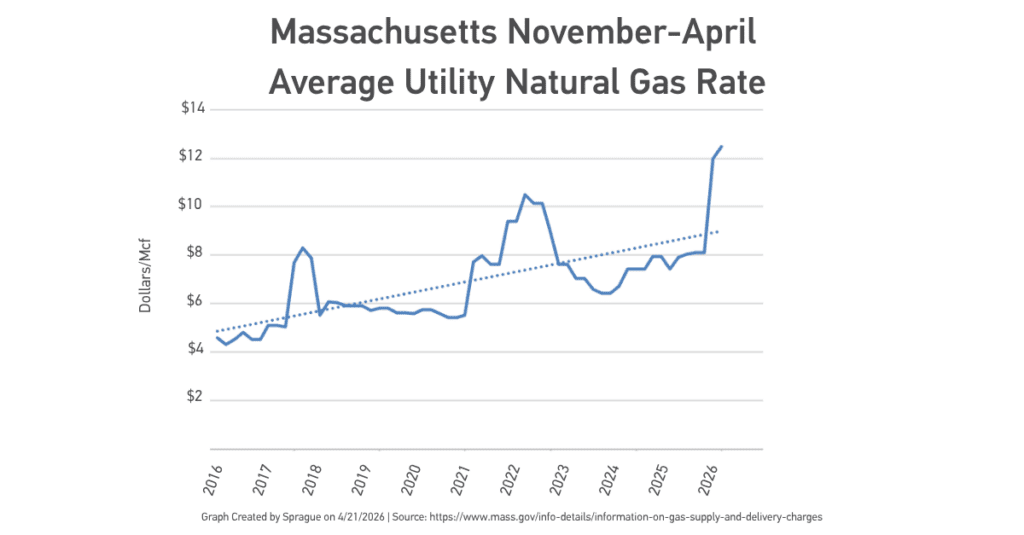
Outside of the conditions that are likely to affect the winter rate in November, when you look at the average winter (November-April) utility price for natural gas in Massachusetts over the last 10 years, the upward trend is clear. The average Massachusetts utility natural gas rate has increased over the last decade. This is a steeper climb than we see in other neighboring markets.
What this Means if You’re on Default Service
When a business buys natural gas through utility default service, it pays whatever the utility’s approved rate happens to be in any given period. There is no contract, no hedge, and no pricing commitment that protects against the next adjustment.
That means two things in practice:
- Winter exposure is full. When peak season rates take effect November 1 each year, default utility customers absorb the change directly, including any mid-season revisions or carryover from the prior year.
- Budgeting gets harder. The wider the seasonal swing and the steeper the long-term trend, the harder it is to forecast energy costs more than a quarter or two out.
Many businesses stay on default service simply because they have not had a reason to revisit the decision. With under-collection from last winter still working through the system and forward markets pricing in elevated risk for next winter, the economics of that choice have shifted.
Why Now is the Time to Act
Off-peak months are when forward planning happens. By the time winter arrives, your supply structure for the season is already set. Acting now gives you the time to evaluate options, compare contract structures, and lock in pricing before next winter’s volatility starts to flow through.
A few practical steps:
- Review your current setup. Confirm whether you are on default utility service or with a competitive supplier, and understand exactly how your rate is set.
- Map your exposure. Look at how much of your annual gas spend lands in the winter months. The more concentrated your usage, the more rate volatility hits your budget.
- Understand your options. Fixed, indexed, and blended pricing structures each handle volatility differently. The right choice depends on your risk tolerance, your budget cycle, and how predictable you need your costs to be.
Sprague has been a natural gas supplier for decades, backed by more than 155 years of energy experience across the Northeast. Our team helps businesses across Massachusetts navigate exactly these decisions, with contract structures built around how your business actually uses energy.
If you’re unsure what a natural gas rate increase would look like for your business, we can help you evaluate your situation and the alternative options to consider. Speak with a team member today.