Sprague Regulatory Matters is provided as a courtesy to our customers. Please note that the information contained in Sprague Regulatory Matters is for informational purposes only and should not be construed as legal or business advice on any subject matter. You should not act or refrain from acting on the basis of any information included in this without seeking legal or professional advice.
U.S. on Track for Record Natural Gas Production
Domestic & International – Natural Gas
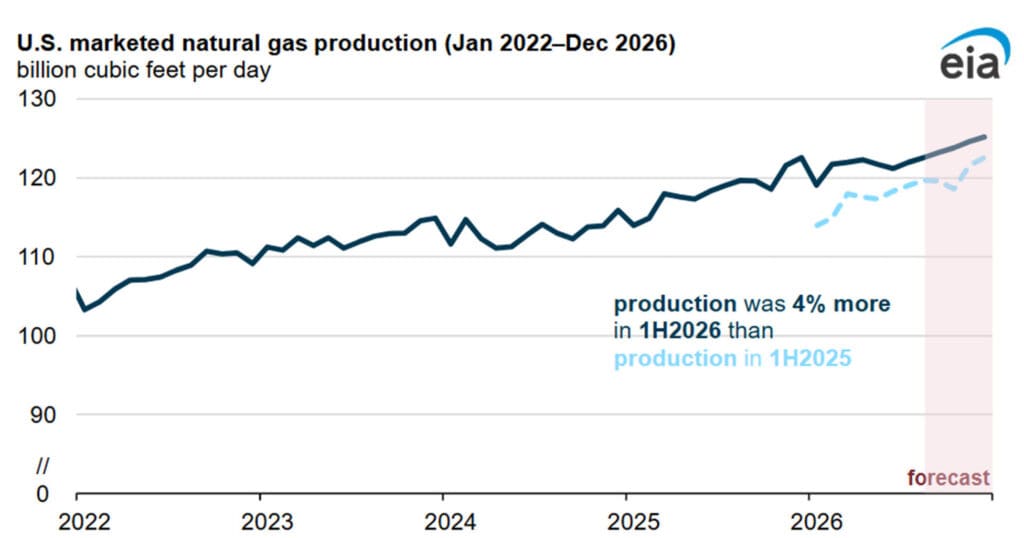
The U.S. Energy Information Administration (EIA) reported that the United States is on track for record natural gas production (United States on track for record natural gas production in 2026 – U.S. Energy Information Administration (EIA)). The EIA forecasts that marketed natural gas production will average 122.5 billion cubic feet per day (Bcf/d) in 2026, surpassing the previous record of 118.5 Bcf/d set in 2025. Most of this expansion is concentrated in the Permian region in Texas and New Mexico and the Haynesville region in Louisiana and Texas. The United States was the world’s largest producer of natural gas from
2009 through 2024, the most recent year for which there is global natural gas production data.
In addition, the EIA reports that global liquefied natural gas (LNG) trade volumes increased 5.4 percent to a record 56.3 Bcf/d, driven largely by U.S. LNG export capacity expanding to meet growing demand. LNG exports from the United States increased by 26 percent to 15.1 Bcf/d in 2025 (Global liquefied natural gas trade volumes reached record high in 2025 – U.S. Energy Information Administration (EIA)). This is a larger increase than from any other country, and the EIA forecasts that U.S. LNG exports will increase further, to 17.4 Bcf/d of LNG in 2026 and 18.6 Bcf/d in 2027. U.S. exports amounted to 26 percent of the global total in 2025, up from 21 percent in 2024. The United States, Qatar, and Australia, the three largest LNG exporters globally, made up a combined 63 percent of global exports, up from 60 percent in 2024.
Natural Gas Industry Seeks Affordability and Reliability in Energy Legislation
Northeast – Electric & Natural Gas
As the Massachusetts Legislature continues to evaluate proposed changes to the competitive energy space in the Commonwealth, the Northeast Gas Association (NGA) voiced its concerns with a letter to the Massachusetts Legislature (NGA_Letter_on_H_5175_S_3143_August_25_2026.pdf). The letter notes the following: (a) the importance of maintaining a balanced approach to affordability and infrastructure modernization and that the House previously passed H.5175, its own energy affordability package, which offers a more balanced approach; (b) natural gas infrastructure investments are not optional extras, but are essential to maintaining a safe system, supporting energy reliability, and keeping energy affordable; (c) natural gas remains a foundation of New England’s energy system, powering as much as 60 percent of the regional electricity generation, and serving as the primary heating fuel for half of Massachusetts homes. During periods of peak demand, especially cold winter days, natural gas is the essential dispatchable energy that underpins electric grid reliability when other generation resources may be limited; (d) NGA supports an all-of-the-above approach that advances clean energy deployment while maintaining dependable fuel diversity and that approach includes reasonable permitting for essential natural gas infrastructure, continued safety-focused pipeline modernization, expanded energy procurement where it improves affordability, maximizing energy efficiency programs that include natural gas technologies, and pragmatic integration of emerging fuels and technologies such as renewable natural gas and hydrogen where viable; and (e) NGA is calling on lawmakers to avoid measures that would prematurely phase out essential gas infrastructure investments and instead focus on reforms that deliver measurable affordability while preserving safety and reliability.
Potential Changes to Utility-Supplied Electric Default Service
Various state jurisdictions are reviewing how electric utilities procure and provide default service electric supply to those customers that do not choose an electric supplier.
Connecticut – Electric
The Connecticut Public Utilities Regulatory Authority issued a draft order that, if ultimately approved, would adopt major changes to the state’s procurement plan for electric standard offer service/default service for customers at or under 500 kilowatts in demand. The proposed changes are designed to lower risk premiums in default service electric rates. The draft order framework provides for dynamic market purchases by the electric distribution companies rather than through a third-party wholesale supplier providing full-requirements contracts for 100 percent of the default service load.
Maine – Electric
During its investigation into the potential development of time-of-use (TOU) rates for default service (and delivery service) rates where the rates charged would vary over time, the Maine Public Utilities Commission recognized that TOU rates may necessitate upgrades to utility metering, billing, customer care, and settlement systems. Accordingly, the commission intends to open a new proceeding in order to evaluate what types of changes may be needed before any potential implementation of TOU rates.
Massachusetts – Electric
The Massachusetts Department of Public Utlities is developing a straw proposal for implementation of time-varying rates (TVR) for electric default service (basic service) in Massachusetts. The Department opened an inquiry into the design and implementation of TVR for default service in response to a petition from the Massachusetts Department of Energy Resources which proposes the implementation of a default, opt-out TOU rate for default service customers.
Potential Expansion of Electric Retail Choice
Texas – Electric
Texas Governor Greg Abbott announces greater consumer choice to deliver lower electric bills (Governor Abbott Announces Greater Consumer Choice to Deliver Lower Electric Bills – Greg Abbott). Through a plan to break up what he calls ‘city monopolies’ like those held by CPS Energy, Austin Energy, and other municipal utilities, Governor Abbott claims his plan would reduce San Antonio bills by 13 percent and noted that more than 5 million Texans live in areas with a single municipal power provider, with 60 percent of those customers living in San Antonio and Austin. His proposal is largely aimed at those two cities;
however, the plan he said he will ask the Legislature to approve could have wide-ranging implications for more than 70 city-owned utilities across the state.
New England Clean Energy Connect Lawsuits
Massachusetts – Electric
Hydro-Québec and three Massachusetts electric utilities have sued each other in a legal dispute related to Hydro-Québec’s temporary halt of power exports over the New England Clean Energy Connect (NECEC) transmission line during the January 2026 cold snap (Maine power line interruptions spark legal battle between Hydro-Quebec, Mass. utilities | WBUR News). In a lawsuit filed in the U.S. District Court for Massachusetts, the subsidiaries of National Grid USA, Unitil Corp. and Eversource Energy said H.Q. Energy Services (U.S.) Inc. (HQUS), violated its power purchase agreement (PPA) when it stopped sending power over the 1,200-megawatt transmission line, shortly after the project became operational. “HQUS violated the PPAs after just eight days of operation by cutting off power deliveries into New England over all or parts of 12 days in the middle of winter, from January 24 through 31 and February 6 through 9, 2026,” the lawsuit said. Hydro-Québec said stopping the power exports was necessary to meet spiking power demand in Quebec brought about by the extreme cold. In its own lawsuit against the electric utilities, Hydro Québec stated that the cold weather constituted a force majeure event that suspended Hydro-Québec’s obligations to send power over the line.
Power Trends 2026: Annual State of the Grid and Markets Report
New York – Electricity & Natural Gas
The New York Independent System Operator (NY-ISO) issued its annual Power Trends report (2026 Power Trends Report) that provides an in-depth look at the forces shaping the future of the New York state electric grid over the next 20 years. Key messages in Power Trends 2026 include: (1) New York’s electricity demand is expected to grow over the next two decades, driven by electrification and emerging large loads that increase total energy needs and reshape when and where demand occurs; (2) all study scenarios require significant new generation, and policy-driven scenarios require far more installed electric generation capacity than exists today to reliably meet demand; (3) transmission capability is increasingly central to system performance, public policy achievement, congestion reduction, and the ability of new resources to serve consumers; and (4) the outlook also shows that the final increments of emissions reductions carry the greatest infrastructure challenges. Study scenarios that move from 95 percent to 100 percent emissions-free electricity require substantially more investment in replacement resources and anticipate technologies not yet available at commercial scale (PRESS RELEASE | NYISO Report Highlights Need for New Generation and Transmission Investment to Meet Growing Demand and State Policy Targets – NYISO). By comparison, other scenarios that also lower emissions significantly do so with much lesser investment in generation and transmission.
For any inquiries, please contact:
Todd Bohan, Senior Manager, Regulatory Compliance tbohan@spragueenergy.com
603.430.5379
Disclosures and Disclaimers
All information is from Sprague unless otherwise noted and has been obtained from sources believed to be reliable, but its accuracy is not guaranteed. There is no representation or warranty as to the current accuracy, reliability or completeness of, nor liability for, decisions based on such information, and it should not be relied on as such.
The views expressed in this material are as of the date of publication and are subject to change based on market and other conditions. This material may contain certain statements that may be deemed forward-looking statements. Please note that any such statements are not guarantees of any future performance or results and actual results or developments may differ materially from those projected.
The information provided is provided for informational purposes only and does not constitute advice and should not be relied on as such. Any strategies and products discussed in the contents of this material may not be suitable for all customers and are not obligations of Sprague or guaranteed by Sprague. Nothing contained in this material should be construed as a solicitation of an offer to buy or an offer to sell a commodity, or recommendation to purchase a commodity or to engage in any other transaction. Nothing contained herein takes into account any customer’s particular objectives, strategies or tax status.
The whole or any part of this work may not be reproduced, copied or transmitted without Sprague’s express written consent.
Neither Sprague nor its employees make any warranty, expressed or implied or statutory, including but not limited to the warranties of noninfringement of third-party rights, title, and the warranties of merchantability and fitness for a particular purpose with respect to content available from Regulatory Matters. Neither does Sprague assume any legal liability for any direct, indirect or any other loss or damage of any kind for the accuracy, completeness, or usefulness of any information, product, or process disclosed herein, and does not represent that use of such information, product, or process would not infringe on privately owned rights.