Sprague Regulatory Matters is provided as a courtesy to our customers. Please note that the information contained in Sprague Regulatory Matters is for informational purposes only and should not be construed as legal or business advice on any subject matter. You should not act or refrain from acting on the basis of any information included in this without seeking legal or professional advice.
Domestic and International Demand Drive Natural Gas Production Growth
International – Natural Gas
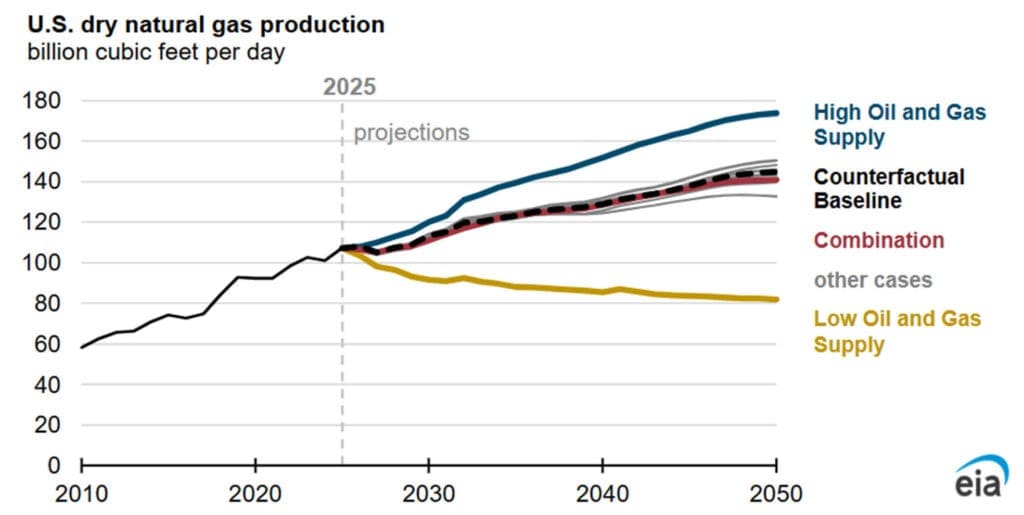
The U.S. Energy Information Administration (EIA) reported that U.S. dry natural gas production, which
accounted for 38 percent of total U.S. energy production in 2025, will increase significantly over the next
several decades, meeting growing domestic and international natural gas demand (Domestic and
international demand drive natural gas production growth – U.S. Energy Information Administration (EIA)).
Most of the growth in production is projected to serve international markets receiving U.S. liquefied
natural gas (LNG). U.S. LNG export volumes are forecasted to grow significantly through the 2040s, from
15 billion cubic feet per day (Bcf/d) in 2025 to over 30 Bcf/d by 2050 in most cases.
Natural Gas Permitting Reform
National – Natural Gas
The Federal Energy Regulatory Commission (FERC) is proposing major reforms to its blanket permitting
process for natural gas facilities, under which companies may construct certain facilities without casespecific
authorization (FERC Unleashes Natural Gas Permit Reforms, Accelerating Infrastructure Upgrades
for Affordable, Reliable Energy Nationwide | Federal Energy Regulatory Commission). The reforms will
further streamline the permitting process and speed up construction of infrastructure on which Americans
rely for affordable and reliable energy, and these changes should accelerate construction by reducing the
regulatory burden. The Notice of Proposed Rulemaking (C-1 | RM25-12-001 | Federal Energy Regulatory
Commission) proposes a plan to permanently overhaul the FERC’s blanket authorization regulations as it
significantly broadens the types and sizes of projects that interstate natural gas pipelines can build without
case-by-case approval.
Pennsylvania-Jersey-Maryland (PJM) Interconnection Governance
PJM Interconnection – Electric
The PJM Interconnection is the largest regional transmission organization in North America and manages
wholesale power markets and electricity delivery for 13 states and the District of Columbia. Federal
Energy Regulatory Commission (FERC) Chairman Laura Swett urged PJM Interconnection leaders to take
action to add generation to the power grid and address a serious crisis that has eroded confidence in PJM
markets. The FERC will hold a technical conference on July 23, 2026 (FERC Issues Notice on Commission-
Led Technical Conference on PJM Governance and Stakeholder Reforms | Federal Energy Regulatory
Commission) for the purpose of identifying and evaluating concrete, actionable reforms to improve PJM
Interconnection’s ability to address operational and market needs in a timely and efficient manner. In
addition, the conference will also explore potential reforms to PJM Interconnection’s governance
structure and stakeholder processes.
2019 Climate Leadership and Community Protection Act
New York – Electric & Natural Gas
New York has scaled back several provisions of the 2019 Climate Leadership and Community Protection
Act (CLCPA), including delaying the timeline for the Department of Environmental Conservation to issue
regulations. This shifts moves toward a 100-year time frame for counting greenhouse gas emissions and
introducing a new 2040 emissions reduction goal. The rollback of the CLCPA is likely to delay the state’s
transition away from natural gas as reliability concerns arise due to retiring natural gas-fired electric
generation.
Natural Gas Impact Fees for Communities
Pennsylvania – Natural Gas
The Pennsylvania Public Utility Commission announced the distribution of $243.8 million in natural gas
impact fees collected from producers for the 2025 reporting year (PUC Announces $243.8 Million in
Natural Gas Impact Fees for Pennsylvania Communities | PA PUC). The funding benefits counties,
municipalities, and state programs. The cumulative total of impact fees collected and distributed since
2012 is over $3 billion. “Pennsylvania’s natural gas industry continues to play an important role in
supporting our economy, strengthening our energy future, and providing tangible benefits to
communities across the Commonwealth,” said Commission Chairman Steve DeFrank. “The impact fee
ensures that local governments and statewide programs share directly in those benefits, delivering
funding for infrastructure, environmental improvements, public safety, and other priorities that
improve quality of life for Pennsylvanians.”
Natural Gas Line Extension Policies
Various state jurisdictions are reviewing natural gas line extension policies. Historically, connection to a
utility natural gas delivery system has been subsidized, at least in part, by other customers through utility
rates providing for line extension installation at no direct (or reduced) cost to the utility customer.
Illinois – Natural Gas
At the directive of the Illinois Commerce Commission, Commission Staff submitted a report that includes
Staff’s review of the Commission’s line extension policies (Illinois Gas Utilities Line Extension Policies
Review). The review includes a detailed consultant report evaluating all the local distribution company
policies. The report concludes that Illinois does not operate under a single uniform gas line extension
framework, natural gas utilities use materially different approaches, and line extension costs are often
funded primarily by existing ratepayers rather than the connecting customer. This awaits further
Commission action.
Maryland – Natural Gas
The Maryland Public Service Commission returned proposed regulations ending line extension allowances
to Commission Staff for additional analysis, delaying implementation indefinitely. The decision came
under the newly appointed Chair. Line extension allowances require all ratepayers to subsidize the cost
of extending natural gas distribution pipes to new buildings, rather than the building developers. The
Commission’s delay marks a retreat from Order 91683, issued in June 2025 under the prior Chair, in which
the Commission stated it was, “persuaded that new natural gas customers should pay the full cost of
extending service to them, thus minimizing any future potential for stranded costs with respect to new
extensions, and reducing any subsidization of gas extensions.”
Minnesota – Natural Gas
The Minnesota Public Utilities Commission voted to retain gas line extension allowances (Minnesota PUC
Tightens Natural Gas Extension Rules, Pushes Efficiency Standards). The Commission stated that it had to
balance the goal of driving down emissions from natural gas systems with the cost for new and existing
customers. Retaining the allowances, within limits, would balance those concerns while ensuring
residents have reliable heating during cold weather. The Commission established distances of 75 feet for
service lines and 80 feet for mains as the maximum size for connecting infrastructure that will not be
charged to new customers, until the Commission approves an alternative maximum distance in a utility’s
general rate case.
Time-Varying Rates (TVR) for Default Service
Massachusetts – Electric
The Massachusetts Department of Public Utilities opened an investigation (Docket No.26-62 – Mass DPU
Fileroom) into the design and implementation of time-varying rates (TVR) for electric default service. The
Department has directed the electric distribution companies (EDCs) to report on numerous technical
aspects of TVR. The Department invited stakeholder comment on consumer protections and the other
issues as follows: (a) identify and describe any consumer protections necessary for a successful design and
implementation of TVR in the Commonwealth; (b) describe implementable strategies for guiding
customer behavior to avoid creating a new system (or grid pocket) peak immediately following the end of
a peak rate period; (c) identify any additional changes required by the EDCs to enable TVR supply rates for
non-demand customers who receive supply from competitive suppliers or municipal aggregation
providers; and (d) identify and describe key elements for inclusion in the EDCs’ implementation and
marketing and outreach plans. After receiving EDC and stakeholder input regarding TVR implementation
and rate design considerations, the Department will determine the next procedural steps of the TVR
investigation.
For any inquiries, please contact:
Todd Bohan, Senior Manager, Regulatory Compliance
tbohan@spragueenergy.com
603.430.5379
Disclosures and Disclaimers
All information is from Sprague unless otherwise noted and has been obtained from sources believed to be reliable, but its accuracy is not guaranteed. There is no representation or warranty as to the current accuracy, reliability or completeness of, nor liability for, decisions based on such information, and it should not be relied on as such.
The views expressed in this material are as of the date of publication and are subject to change based on market and other conditions. This material may contain certain statements that may be deemed forward-looking statements. Please note that any such statements are not guarantees of any future performance or results and actual results or developments may differ materially from those projected.
The information provided is provided for informational purposes only and does not constitute advice and should not be relied on as such. Any strategies and products discussed in the contents of this material may not be suitable for all customers and are not obligations of Sprague or guaranteed by Sprague. Nothing contained in this material should be construed as a solicitation of an offer to buy or an offer to sell a commodity, or recommendation to purchase a commodity or to engage in any other transaction. Nothing contained herein takes into account any customer’s particular objectives, strategies or tax status.
The whole or any part of this work may not be reproduced, copied or transmitted without Sprague’s express written consent.
Neither Sprague nor its employees make any warranty, expressed or implied or statutory, including but not limited to the warranties of noninfringement of third-party rights, title, and the warranties of merchantability and fitness for a particular purpose with respect to content available from Regulatory Matters. Neither does Sprague assume any legal liability for any direct, indirect or any other loss or damage of any kind for the accuracy, completeness, or usefulness of any information, product, or process disclosed herein, and does not represent that use of such information, product, or process would not infringe on privately owned rights.