
When most people picture solar panels, they imagine bulky, glass-framed arrays perched on pitched residential roofs or large solar arrays in a field. But for commercial and industrial buildings with flat or lightly engineered rooftops, a glass panel system often isn’t feasible. That’s where thin-film solar comes in.
What Makes Thin-Film Different?
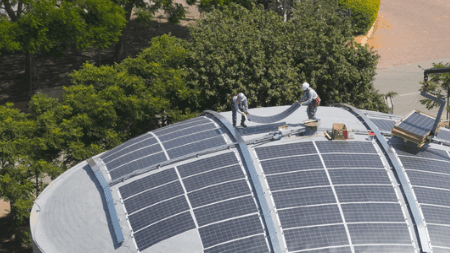
Unlike traditional rigid panels, thin-film systems are lightweight and flexible. Instead of relying on racks or roof penetrations, these panels adhere directly to the roof—conforming to both flat and curved surfaces. This reduces structural load and simplifies installation, often with no interruption to operations or need for reinforcement.
That makes thin-film solar especially well suited for:
- Warehouses and distribution centers
- Manufacturing facilities
- Liquid fuel terminals
- Transit and municipal buildings
- Older buildings with limited structural capacity
Built for Real-World Conditions
Some thin-film panels, like Sprague’s solar systems, are even engineered to withstand harsh environments—performing in high winds, extreme temperatures, hail, and snow. These systems are an ideal solution for facilities operating in coastal or industrial zones where durability is non-negotiable.
These panels also give you the same advantages of traditional solar:
- Reduced dependence on the grid
- More stable, predictable energy costs
- Visible progress toward sustainability goals
- Protection for roof surfaces from UV and weather exposure
Proven in the Field
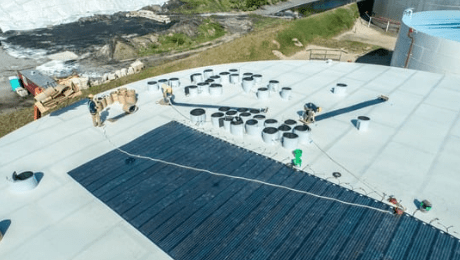
We’ve seen firsthand how thin-film solar performs on industrial rooftops. When we installed solar on our own liquid fuel storage tanks, we saw consistent output, no operational downtime, and a powerful return from what used to be just an underutilized surface.
Thin-film solar is more than a work around, it’s a serious solar solution built for a wide range of infrastructure. Learn more here.