Sprague Regulatory Matters is provided as a courtesy to our customers. Please note that the information contained in Sprague Regulatory Matters is for informational purposes only and should not be construed as legal or business advice on any subject matter. You should not act or refrain from acting on the basis of any information included in this without seeking legal or professional advice.
Natural Gas Consumption Increased in 2025
National – Electric & Natural Gas
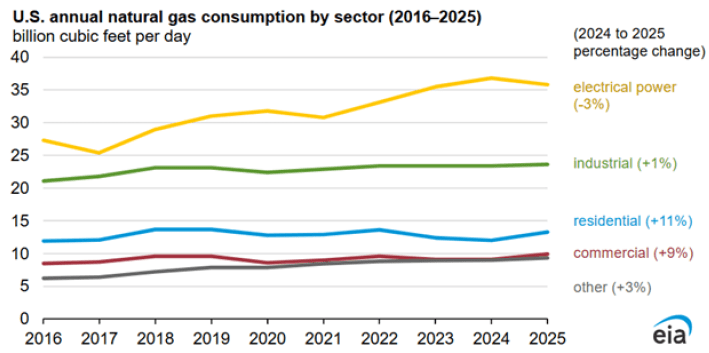
The U.S. Energy Information Administration (EIA) reported (U.S. natural gas consumption set a monthly and yearly record in 2025 – U.S. Energy Information Administration (EIA)) natural gas consumption averaged a record 92 billion cubic feet per day (Bcf/d) in 2025 and set a new winter monthly record of 126.6 Bcf/d in January 2025. Overall, U.S. natural gas consumption last year increased 2 percent (1.7 Bcf/d) from 2024. In January 2025, natural gas consumption was up 5 percent (6.3 Bcf/d) compared with January 2024. However, changes in U.S. natural gas consumption in 2025 varied by sector with residential and commercial consumption accounting for most of the year-over-year increase, particularly during the first quarter of 2025.
National Electric Generation and Capacity Additions
National – Electric
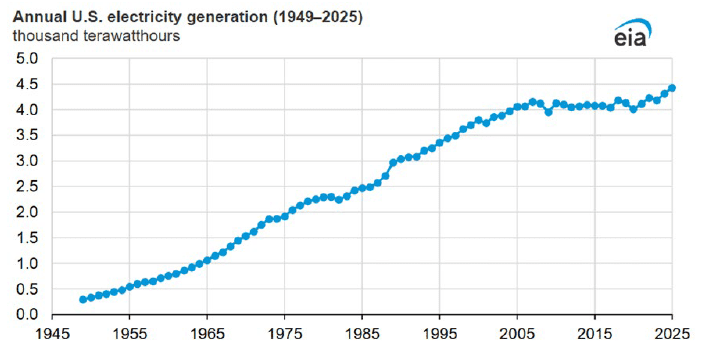
According to the U.S. Energy Information Administration (EIA), U.S. electricity net generation reached a record in 2025 (U.S. electricity generation in 2025 hit a record, again – U.S. Energy Information Administration (EIA)). In 2025, the United States generated 4.43 thousand terawatt hours (TWh) of electricity, up 2.8 percent from 2024 generation, which previously had been the highest annual total in EIA’s dataset dating back to 1949.
According to the U.S. EIA, U.S. power plant developers and operators plan to add 86 gigawatts (GW) of new utility-scale electric generating capacity to the U.S. power grid in 2026 (New U.S. electric generating capacity expected to reach a record high in 2026 – U.S. Energy Information Administration (EIA)). This would be a record addition to the generation stock if this is completed as expected. The composition of the proposed 86 gigawatts of capacity is comprised primarily of solar (43.4 GW), battery storage (24.3 GW), wind (11.8 GW), and natural gas (6.3 GW).
American Gas Association 2026 Playbook
National – Natural Gas
The American Gas Association (AGA) has released its 2026 Playbook (Sustainable | AGA 2026 Playbook) that provides an assessment of America’s natural gas utilities and notes the benefits of natural gas. More than 189 million Americans and 5.8 million businesses rely on natural gas every day, with utilities adding more than one new residential customer every minute. The AGA 2026 Playbook asserts the following: (1) Natural gas keeps energy bills lower. Households that use natural gas for heating and daily activity save, on average, over of $1,000 per year compared to homes that use electricity for those same applications. (2) Natural gas delivers reliability when it matters. A majority of adults view natural gas as a reliable way to heat their home, cook and handle daily household needs. (3) Safety is the industry’s top priority. America’s natural gas utilities invest $37 billion annually to enhance the safety of natural gas distribution and transmission systems that support modernization, system integrity work and technologies that help utilities prevent incidents before they happen. (4) Natural gas is essential for a more sustainable future. Emissions from natural gas distribution systems have declined 70 percent since 1990 due to the innovative work of the natural gas industry. (5) Smart innovation is moving the industry forward and helping to meet rising demand. Natural gas utilities have been meeting rising demand while keeping prices stable with nearly 50 percent growth since 2006, and lowering emissions by implementing innovative technologies such as renewable natural gas and hydrogen to fuel a cleaner future. The full playbook along with other resources are available on the AGA website.
Legislation Introduced to Allow for Electric Retail Choice
Indiana – Electric
Legislation has been introduced in the Indiana General Assembly (IGA | Senate Bill 272 – Competitive electric supply service) that, if approved, would allow large customers to shop for competitive electric supply. Senate Bill 272 would allow a new or existing non-residential customer, or an aggregation of two or more new or existing non-residential customers, whose aggregate electricity demand during the most recently concluded calendar year exceeded 1 megawatt (MW) to shop for electricity. The bill would cap competitive electric sales at 20 percent of a utility’s total retail sales, normalized for weather, for the most recently concluded calendar year; however, the cap would exclude sales to eligible customers whose demand exceeded 75 MW at one site. The local distribution company would not be allowed to impose transition or exit fees on shopping customers and dual billing would be required.1
Missouri – Electric
Legislation has been introduced in the Missouri Legislature (MO HB2233 | 2026 | Regular Session | LegiScan) that, if enacted into law, would provide for electric retail choice in the state of Missouri. A new House Bill 2233, and two previous bills (Senate Bill 1411) and (House Bill 2207) have been reintroduced. Generally, the bills would require that commercial and industrial electric retail choice start in August 2028 and that residential retail choice begin no later than 18 months after commercial and industrial choice has commenced.
Natural Gas Infrastructure Projects
National & Northeast – Natural Gas
Enbridge sees opportunities for gas pipeline expansions across the United States, including a potential expansion of its Algonquin Gas Transmission pipeline in the Northeast, according to President and CEO Greg Ebel.2 The Company’s gas transmission business is “the largest opportunity set of our core franchises, driven by industrial and power demand, along with growing LNG exports and storage,” Ebel said during the Enbridge fourth-quarter 2025 earnings call in February. “Currently, we’re advancing over 50 potential data center opportunities that could require up to 10 [billion cubic feet per day] of natural gas, and we expect to begin sanctioning these additional projects throughout 2026 and more in 2027,” Ebel said. The Algonquin Reliable Affordable Resilient Enhancement project3, which would add gas transportation capacity of 75 Mcf/d [million cubic feet per day], is expected to enter service in 2029. “We have a relatively small expansion going on in Algonquin, but there’s an appetite for [a] large expansion there,” said Matthew Akman, president of gas transmission.
Northeast – Natural Gas
The Federal Energy Regulatory Commission issued a notice starting a review of the petition to revive the 125-mile Constitution Pipeline natural gas transportation project (Constitution Pipeline | Williams Companies). The high-profile Constitution gas pipeline project was designed to add 650,000 dekatherms per day (Dth/d) of gas transportation service from Pennsylvania to areas in New York and New England.
The New Jersey Department of Environmental Protection issued an air quality permit for the Northeast Supply Enhancement (NESE) natural gas pipeline and compressor station (Northeast Supply Enhancement | Williams Companies). The $1 billion project, proposed by Transcontinental Gas Pipe Line Corporation, would transport natural gas from Pennsylvania to the New York City area through an underground pipeline that goes through Hunterdon, Somerset and Middlesex counties to Raritan Bay where a submarine pipeline will take the gas to Long Island. The NESE project includes construction of a new gas-powered compressor station in Franklin Township and 3.5 miles of new connecting pipeline through Old Bridge along with 23 miles of new pipeline under the Raritan Bay/New York Harbor.
Annual Report on Electric Competition
Connecticut – Electric
The Connecticut Public Utilities Regulatory Authority submitted to the Legislature its Annual Report on the State of Electric Competition (25-11-01 Legislative Report.pdf). The report includes various details and statistics on customer complaints, residential and business standard offer service rates, and the number of suppliers and aggregators operating within the state. In 2025, Connecticut had 33 suppliers and aggregators serving approximately 286,000 customers (17 percent of all electric distribution company customers) and accounted for roughly 51 percent of all electricity sales.
Michigan – Electric
The Michigan Public Service Commission issued its annual report on electric competition (State’s electric choice program remains fully subscribed in 2025). Michigan legislation restricts that no more than ten percent of an electric utility’s average weather-adjusted sales for the preceding calendar year may take service from an alternative supplier. While participation by residential customers continues to be non-existent, some highlights include the following: (1) There were approximately 5,500 customers participating in the electric choice programs, up slightly from the prior year, and this represents approximately 2,200 megawatts of electric demand, which is a slight decrease from 2024. (2) As of December 2025, an additional 5,100 customers remained in a queue to take service from an alternative supplier. (3) The electric choice participation remained around ten percent for each utility. (4) Every Michigan licensed supplier is now subject to capacity demonstration and state reliability mechanism provisions requiring that they have enough resources to serve customers four years forward and if they do not, they are subject to a Commission-approved capacity charge. (5) There are 21 licensed alternative suppliers with seven actively serving customers in the state.
- This proposed legislation is similar to what is currently in place in Michigan where up to 10 percent of an electric utility’s customer load is permitted to shop and acquire their own electric supply. This 10 percent cap has been fully subscribed since 2008 with more than 5,000 commercial and industrial customers being served by a third-party supplier. ↩︎
- Release Details – Enbridge Inc. ↩︎
- Algonquin Reliable Affordable Resilient Enhancement – Enbridge Inc. ↩︎
For any inquiries, please contact:
Todd Bohan, Senior Manager, Regulatory Compliance tbohan@spragueenergy.com
603.430.5379
Disclosures and Disclaimers
All information is from Sprague unless otherwise noted and has been obtained from sources believed to be reliable, but its accuracy is not guaranteed. There is no representation or warranty as to the current accuracy, reliability or completeness of, nor liability for, decisions based on such information, and it should not be relied on as such.
The views expressed in this material are as of the date of publication and are subject to change based on market and other conditions. This material may contain certain statements that may be deemed forward-looking statements. Please note that any such statements are not guarantees of any future performance or results and actual results or developments may differ materially from those projected.
The information provided is provided for informational purposes only and does not constitute advice and should not be relied on as such. Any strategies and products discussed in the contents of this material may not be suitable for all customers and are not obligations of Sprague or guaranteed by Sprague. Nothing contained in this material should be construed as a solicitation of an offer to buy or an offer to sell a commodity, or recommendation to purchase a commodity or to engage in any other transaction. Nothing contained herein takes into account any customer’s particular objectives, strategies or tax status.
The whole or any part of this work may not be reproduced, copied or transmitted without Sprague’s express written consent.
Neither Sprague nor its employees make any warranty, expressed or implied or statutory, including but not limited to the warranties of noninfringement of third-party rights, title, and the warranties of merchantability and fitness for a particular purpose with respect to content available from Regulatory Matters. Neither does Sprague assume any legal liability for any direct, indirect or any other loss or damage of any kind for the accuracy, completeness, or usefulness of any information, product, or process disclosed herein, and does not represent that use of such information, product, or process would not infringe on privately owned rights.