Rhode Island natural gas rates have climbed steadily over the last ten years. The increases don’t always show up all at once or even consistently. They tend to come in steps, holding flat for months at a time before resetting, sometimes lower, more often higher. That pattern can make the long-term trend easy to miss if you’re only looking at your most recent bill. But for businesses that have stayed on utility default service throughout, the cumulative effect is real. What businesses need to know: they don’t have to be at the mercy of the utility. They can shop for a rate structure that’s built around their own business instead.
The Ten-Year Natural Gas Cost Trend in Rhode Island
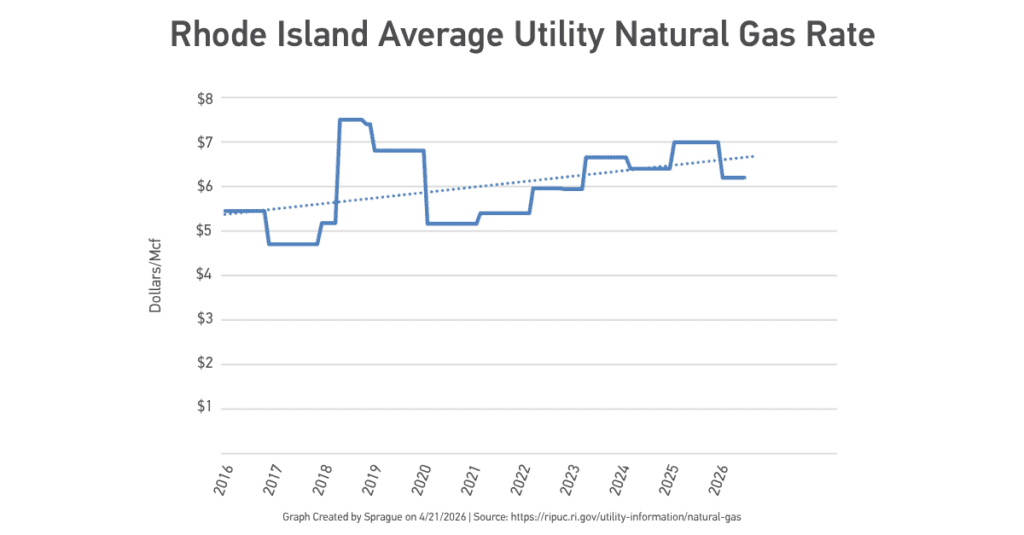
The data shows that in 2016, the average commodity rate sat around $5.46 per thousand cubic feet for most of the year. By 2025, it had moved to roughly $7.00. The line moves in steps rather than gradually, often holding flat for ten or twelve months at a time before resetting.
This isn’t a story of wild swings year to year, or even a constant step up. The trend shows us two things: the rate is not as stable as it may seem month to month, and the long-term trend shows a gradual increase.
How Commodity Rates Work in Rhode Island
The price you pay Rhode Island Energy for natural gas has two main parts. There’s the delivery side, which covers the cost of moving gas through the pipeline system. And there’s the commodity side, which covers what the utility actually pays for the gas itself. If your business is in a deregulated state like Rhode Island, a competitive supplier can replace the commodity portion of your bill. Delivery stays with the utility either way. If you’re not sure how energy deregulation works or whether your business qualifies, this overview is a good place to start.
The commodity rate is set through a process called a Gas Cost Recovery (GCR) filing. Rhode Island Energy submits this filing each year, and the rate goes into effect November 1. It’s designed to cover the utility’s projected gas costs for the twelve months ahead. When actual costs come in higher than projected, the utility can carry that gap forward as a deferred balance and recover it in a future rate period.
How Rate Classes Actually Work
Every business on Rhode Island Energy’s default service is sorted into a rate class based on how much gas it uses and how it uses it. The main groupings are Residential Heating, Residential Non-Heating, and then Small, Medium, Large, and Extra-Large Commercial and Industrial, with some of those further split by load pattern.
Here’s what that structure actually means for your business: every company in your class pays the same rate, on the same schedule, regardless of how your business specifically operates. A restaurant with a walk-in freezer running around the clock and a seasonal retail shop with light winter heating needs might land in the same Commercial and Industrial class and pay the exact same rate structure, even though their actual usage patterns look nothing alike.
That’s not a flaw in how utilities operate. Rate classes exist because a utility has to serve everyone the same way, at scale, without room to negotiate terms business by business. It’s simply the tradeoff of default service: predictable for the utility to administer, but not built around your business specifically.
A competitive supply agreement works differently. Instead of being grouped into a class, your contract can reflect your actual usage pattern, your budget cycle, and how much price variability your business can reasonably take on.
What You Can Actually Do About It
With a third-party supplier, you have more say in how your supply contract is structured. Depending on what fits your business, those options can include:
- A fixed price for a term you choose, locking in a known commodity rate for the length of the contract. A good fit if budget predictability is the priority and you want to take rate uncertainty off the table.
- An index price that floats with the market, giving you exposure to lower prices when markets soften, while accepting more exposure when they rise.
- A blended approach that locks in part of your usage at a fixed price and buys the rest at market prices. Some stability for your baseline volume, some flexibility if markets move in your favor.
The right answer depends on your usage profile, your budget cycle, and how much price variability your business can absorb. That conversation is worth having before the next rate cycle, not after.
The Bottom Line
Rhode Island commodity gas rates have climbed steadily for a decade, and every business in a rate class absorbs the same adjustment on the same schedule, whichever direction the number moves. If your business has been on utility default service through all of it, you’ve absorbed every rate cycle without a say in how it was structured.
Sprague has been a natural gas supplier for decades, backed by more than 155 years of energy experience across the Northeast. Our team works with businesses across Rhode Island to build supply structures that fit their goals, whether that’s locking in certainty, gaining pricing flexibility, or simply getting ahead of the next rate cycle instead of reacting to it.
If you’re not sure how the current rate environment affects your business, we can help you think through your options. Speak with a team member today.